
AI Generated
Black Lechwe
Kobus leche smithemani
The Black Lechwe is an antelope species endemic to the wetlands of Zambia, known for its dark coat in males and water-loving habits.
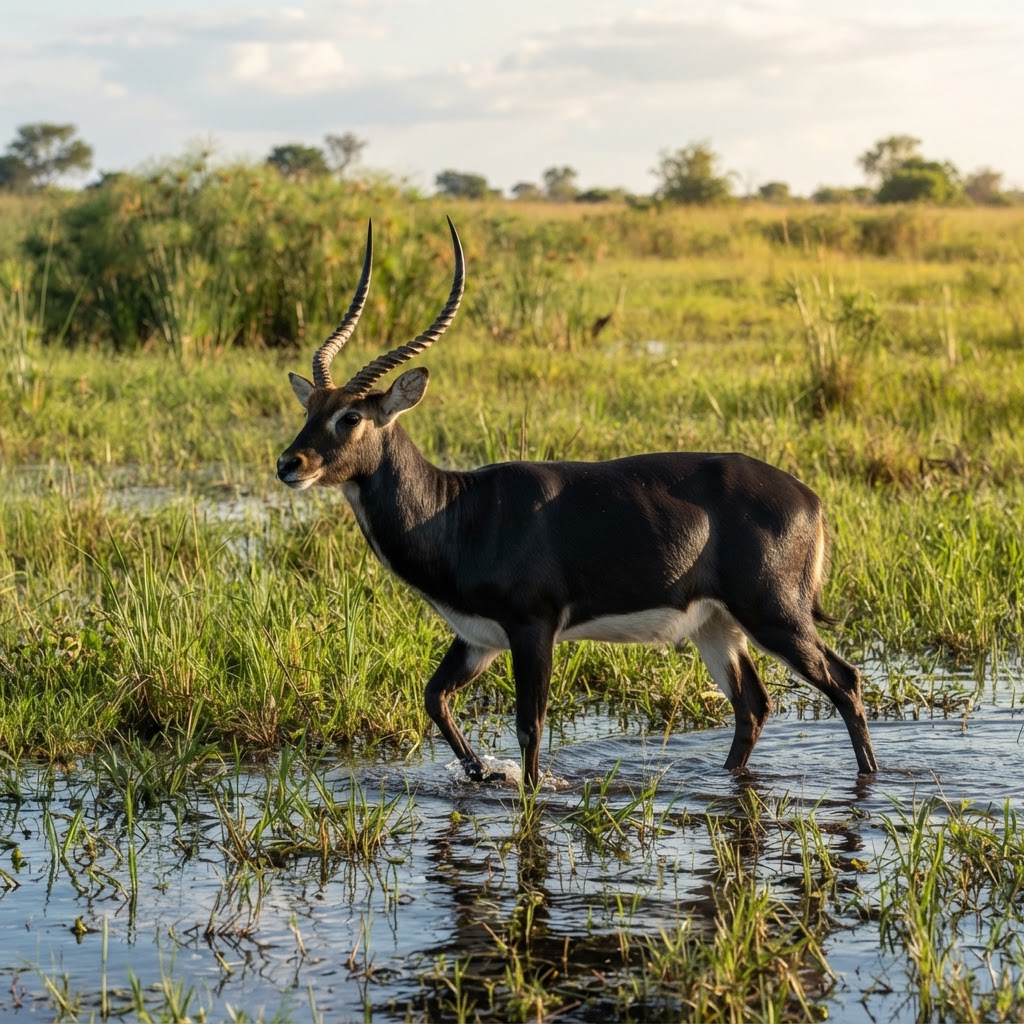
The Black Lechwe (Kobus leche smithemani) is a dark-colored subspecies of lechwe native to the wetlands of northern Zambia. Mature males are particularly distinctive, developing a deep blackish-brown coat that contrasts sharply with their pale underparts.
Males are larger and heavier than females and carry long, strongly ridged horns that sweep backward before curving upward. Females are hornless and retain a lighter reddish-brown coloration throughout life.
Habitat & Range
The Black Lechwe is found primarily in Zambia’s Bangweulu wetlands and surrounding floodplain systems.
It is closely associated with shallow water, seasonally flooded grasslands and open marshes. The species is highly adapted to wetland habitats and is rarely found far from water.
Behavior
Black Lechwe are highly social and are often seen in large herds, particularly where suitable grazing is concentrated.
They are strong swimmers and move easily through shallow water and flooded grassland. During the breeding season, mature males become more territorial and compete for access to females.
Diet
The Black Lechwe is primarily a grazer, feeding on grasses and aquatic vegetation found in and around wetland areas.
Seasonal flooding plays an important role in food availability, with fresh grass growth providing high-quality forage as water levels change.
Hunting & Identification Notes
Mature males are identified by their dark coat, heavier build and well-developed curved horns.
Trophy assessment focuses mainly on horn length, mass, spread and symmetry. Older males usually show darker coloration and heavier horn bases than younger animals.
Because Black Lechwe occupy wet, open habitats, hunting often involves glassing across floodplains and marsh edges where mature males can be identified at distance.
Conservation Status
The Black Lechwe has a restricted natural range and is therefore particularly dependent on the long-term protection of the Bangweulu wetland ecosystem.
Its populations have historically been affected by hunting pressure, habitat disturbance and changes to wetland management, although conservation and regulated wildlife management have helped maintain important populations.
Sources
Mammal Diversity Database — Kobus leche
https://www.mammaldiversity.org/taxon/1006365/
IUCN Red List — Lechwe
https://www.iucnredlist.org/species/11033/50189021
Animal Diversity Web — Kobus leche