
AI Generated
Beisa Oryx
Oryx beisa
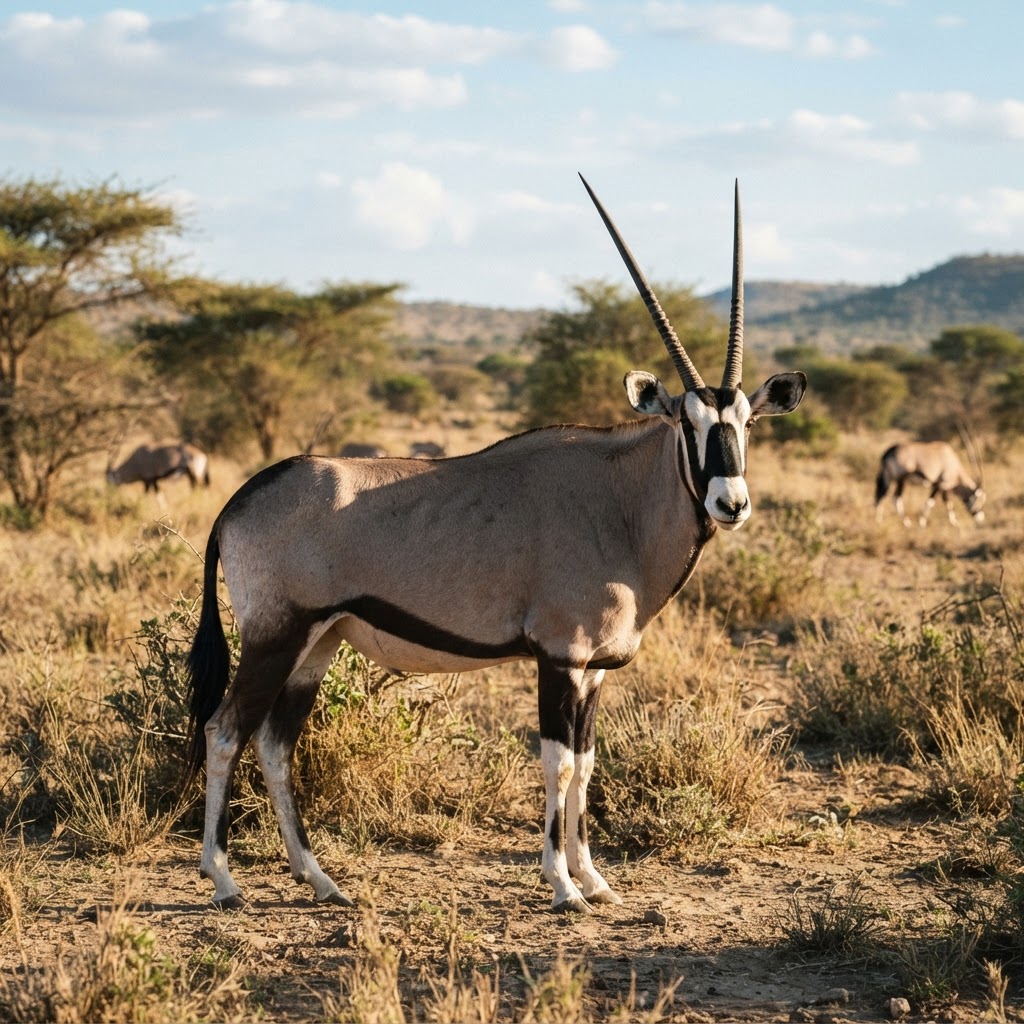
The Beisa Oryx is a large antelope of East Africa, recognized by its striking black and white facial markings and long, straight horns.
The Beisa Oryx (Oryx beisa) is a large, striking antelope native to East Africa. It is recognized by its long, straight horns, pale grey coat, black facial markings and bold dark stripe along the flanks.
Both males and females carry horns, although males are usually heavier and more robust. The horns can grow to impressive lengths and are almost perfectly straight, making the species one of the most distinctive members of the oryx group.
Habitat & Range
The Beisa Oryx occurs primarily in East Africa, including Ethiopia, Kenya, Somalia and parts of northern Tanzania.
It inhabits dry savanna, semi-arid grassland, scrub and open bush country. The species is well adapted to hot, dry environments and can survive for extended periods with limited access to free-standing water.
Behavior
Beisa Oryx are social antelope and are commonly found in small to medium-sized herds.
They are most active during the cooler parts of the day and often rest during the hottest hours. When threatened, they rely on speed, endurance and their long horns for defense.
Diet
The Beisa Oryx is primarily a grazer, feeding on grasses and other herbaceous vegetation.
During dry periods it may also browse on leaves, shoots and other available plant material. Its ability to conserve water allows it to remain in arid areas where many other large antelope struggle to survive.
Hunting & Identification Notes
The Beisa Oryx is easily identified by its pale body color, black facial pattern, dark flank stripe and very long, straight horns.
Both sexes can carry impressive horns, so body size, horn thickness and overall build are important when identifying mature males. Trophy assessment focuses mainly on horn length, basal mass and symmetry.
Care should be taken to distinguish the Beisa Oryx from closely related East African oryx forms where their ranges or hunting classifications overlap.
Conservation Status
The Beisa Oryx has declined in parts of its historical range because of habitat loss, livestock competition, hunting pressure and increasing human settlement.
Although populations remain in several protected and managed areas, the species is more restricted and fragmented than it was historically.
Sources
Mammal Diversity Database — Oryx beisa
https://www.mammaldiversity.org/taxon/1006384/
IUCN Red List — Beisa Oryx
https://www.iucnredlist.org/species/15568/50191626
Animal Diversity Web — Oryx beisa