
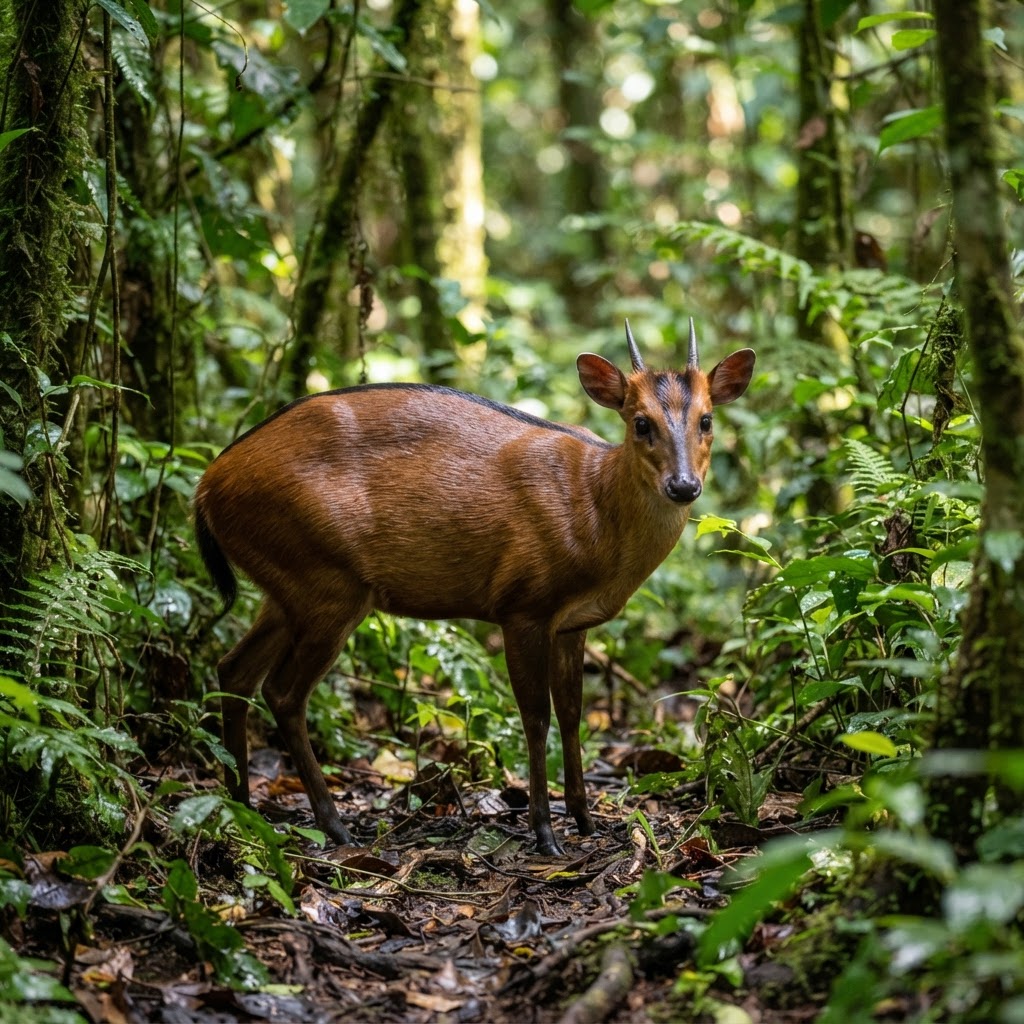
AI Generated
Bay Duiker
Cephalophus dorsalis
The Bay Duiker is a small, shy forest antelope found in West and Central Africa, characterized by its reddish-brown coat.
The Bay Duiker (Cephalophus dorsalis) is a small, stocky forest antelope found in the tropical forests of West and Central Africa. It is characterized by its rich reddish-brown coat, dark dorsal stripe and compact build, all of which help it move efficiently through dense vegetation.
Adult males and females are similar in size, and both sexes may carry short, straight horns, although the horns are usually more developed in males. The species has a relatively short neck, rounded body and strong hindquarters adapted for rapid movement through thick forest cover.
Habitat & Range
The Bay Duiker occurs across the lowland rainforests of West and Central Africa, from Sierra Leone and Liberia eastward through countries such as Côte d’Ivoire, Ghana, Cameroon, Gabon and the Republic of the Congo.
It is strongly associated with dense primary and secondary forest, particularly areas with thick undergrowth, fallen fruit and access to water. It is rarely seen far from heavy cover.
Behavior
Bay Duikers are primarily nocturnal and highly secretive. During daylight hours they usually remain concealed in dense vegetation and become more active from dusk through the night.
They are generally solitary and territorial. When disturbed, they typically escape by making short, rapid runs through thick vegetation rather than relying on prolonged speed.
Diet
The Bay Duiker is an omnivorous browser with a diet consisting mainly of fallen fruit, leaves, shoots and other plant material.
It may also consume insects, eggs, small vertebrates and carrion when available. Fallen fruit from forest trees is particularly important and influences where the animals spend much of their feeding time.
Hunting & Identification Notes
The Bay Duiker is identified by its deep reddish-brown coloration, dark stripe running along the back and compact, heavy-bodied appearance.
Compared with many other forest duikers, it has a robust build and relatively dark coloration. Trophy assessment focuses mainly on horn length, basal mass and symmetry.
Because Bay Duikers are nocturnal and rarely leave dense forest cover, they can be difficult to observe. Correct identification is important in areas where several duiker species occur together.
Conservation Status
The Bay Duiker is generally regarded as one of the more widespread forest duikers, but local populations can be heavily affected by hunting pressure and habitat loss.
Bushmeat hunting, commercial logging and conversion of tropical forest remain the principal threats across much of its range.
Sources
Mammal Diversity Database — Cephalophus dorsalis
https://www.mammaldiversity.org/taxon/1006216/
IUCN Red List — Bay Duiker
https://www.iucnredlist.org/species/4151/50183433
Animal Diversity Web — Cephalophus dorsalis