
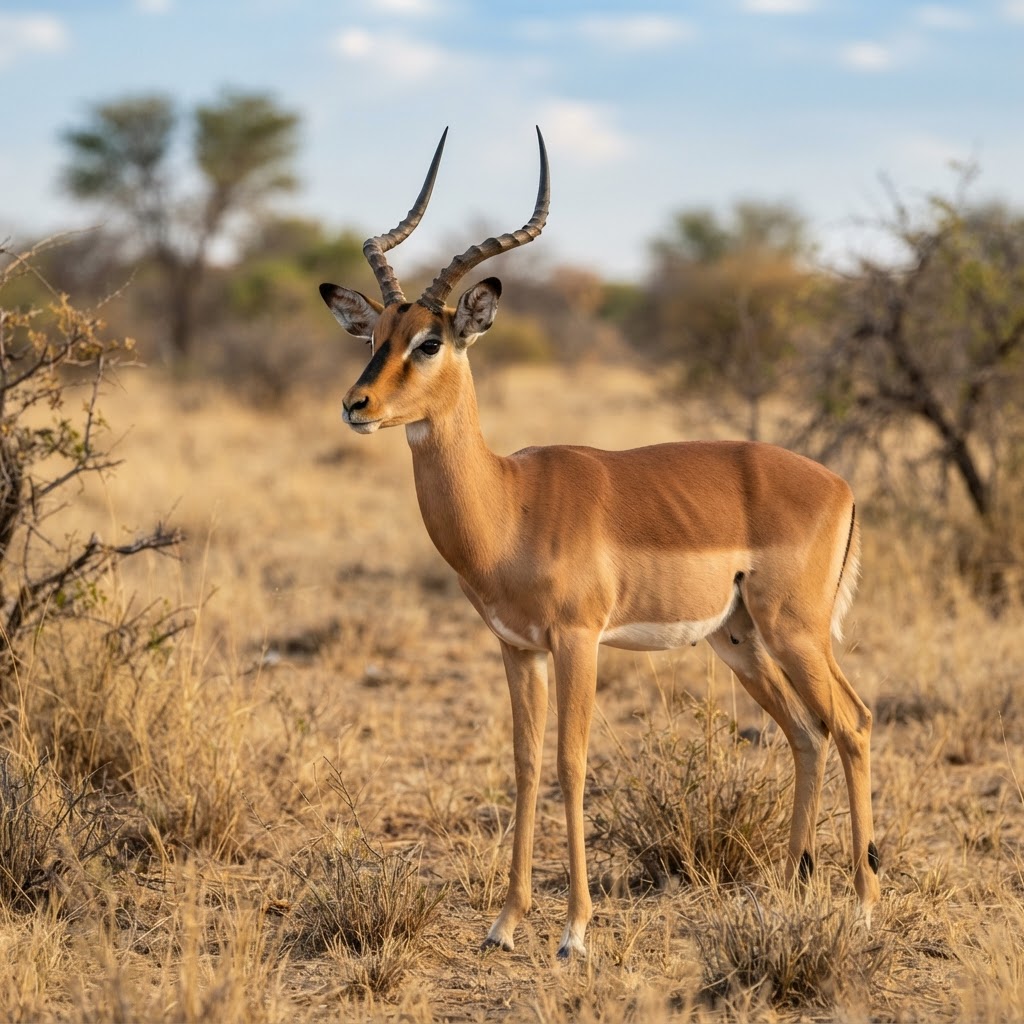
AI Generated
Angolan or Black-faced Impala
Aepyceros melampus petersi
The Angolan or Black-faced Impala is a striking subspecies known for its distinctive dark facial markings and elegant build.
The Angolan or Black-faced Impala (Aepyceros melampus petersi) is a distinctive subspecies of impala native to southwestern Africa. It is best known for the dark facial markings that give it its common name and for its restricted natural range in Angola and northern Namibia.
Adult males are larger than females and carry long, ridged, lyre-shaped horns. Both sexes have a reddish-brown coat with lighter underparts and the characteristic black markings on the face, rump and tail. The facial stripe is generally more pronounced than in the common impala.
Habitat & Range
The Black-faced Impala occurs naturally in southwestern Angola and northern Namibia, particularly in and around the Kunene region.
It inhabits open woodland, savanna and bushveld, usually in areas with access to water and a mixture of grazing and browsing opportunities. Populations have also been established in protected and managed areas outside the core natural range.
Behavior
Black-faced Impala are social antelope and are commonly found in herds. Females and young usually form larger groups, while adult males may be solitary, form bachelor groups or defend territories during the breeding season.
They are alert and agile animals, relying on speed and powerful leaps to escape predators. Activity is greatest during the cooler parts of the day.
Diet
The Black-faced Impala is a mixed feeder, switching between grazing and browsing depending on season and food availability.
During wetter periods it feeds heavily on fresh grasses, while leaves, shoots and shrubs become increasingly important during the dry season.
Hunting & Identification Notes
The most important field identification feature is the prominent dark facial marking, combined with the typical impala body shape and the male’s lyre-shaped horns.
Mature trophy males are assessed primarily by horn length, mass, width and symmetry. As with other impala, horn tips that flare outward and good basal mass are characteristic of older males.
Because the Black-faced Impala has a limited natural distribution and is managed separately from the common impala in many hunting systems, correct subspecies identification and documentation are important.
Conservation Status
The Black-faced Impala has a much more restricted distribution than the common impala and has historically been vulnerable to habitat change, drought, disease and population isolation.
Conservation programs in Namibia have played an important role in maintaining and expanding populations, particularly through protection, translocation and managed breeding.
Sources
IUCN Red List — Aepyceros melampus
https://www.iucnredlist.org/species/550/50180828
Mammal Diversity Database — Aepyceros melampus
https://www.mammaldiversity.org/taxon/1006186/
Namibia Ministry of Environment, Forestry and Tourism
Animal Diversity Web — Aepyceros melampus