
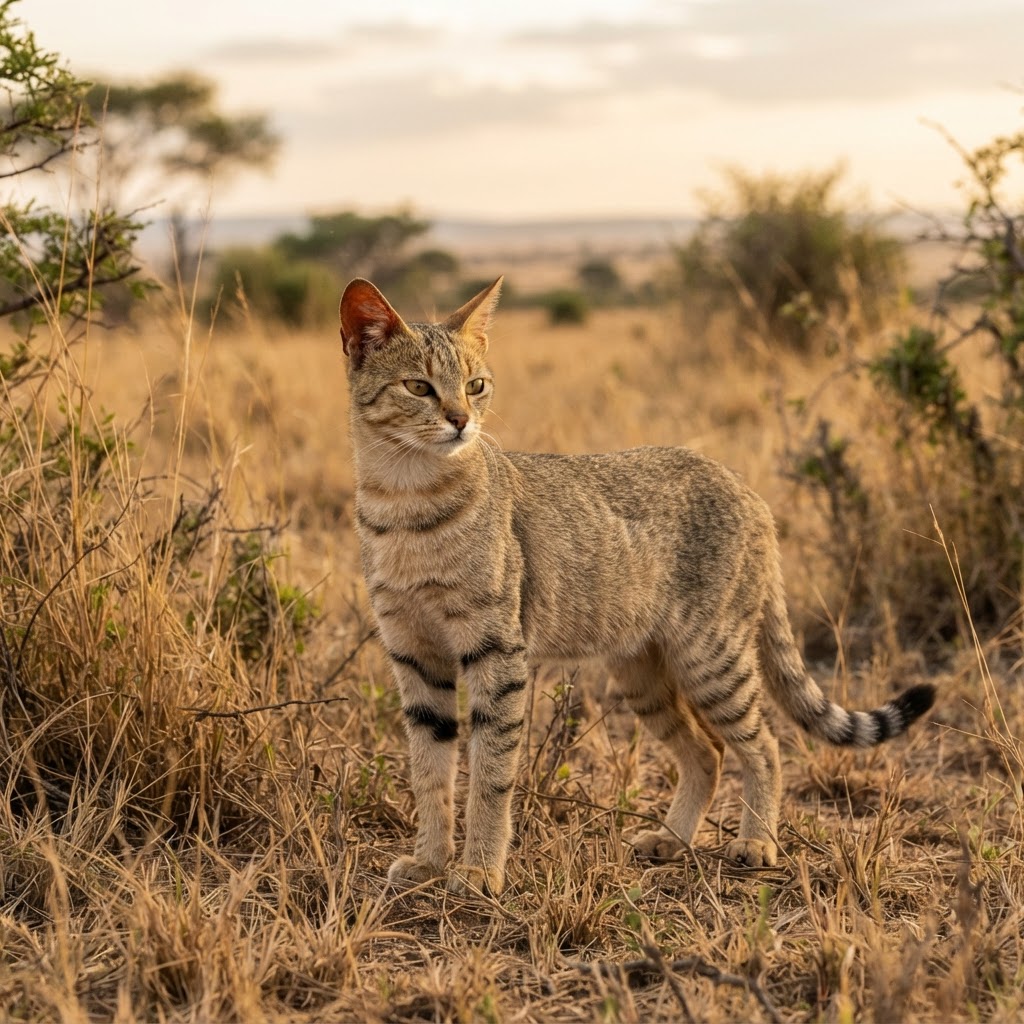
AI Generated
African Wild Cat
Felis lybica
The African Wild Cat is a small wild feline native to Africa, known for being the ancestor of the domestic cat.
The African Wild Cat (Felis lybica) is a small wild feline native to Africa and parts of the Middle East. It closely resembles a domestic tabby cat but is generally more lightly built, with longer legs, a sandy-grey coat and a distinctively banded tail.
Adult African Wild Cats typically have a body length of around 45–75 cm (18–30 inches), excluding the tail. Coat color varies with habitat, ranging from pale sandy tones in arid regions to greyer shades in more temperate areas. Dark stripes are usually visible on the legs, face and tail.
Habitat & Range
The African Wild Cat is widely distributed across Africa, occurring from North Africa through sub-Saharan regions and into southern Africa.
It occupies a broad range of habitats, including savanna, semi-desert, scrubland, open woodland and agricultural areas. It generally avoids dense rainforest and the driest parts of true desert.
Behavior
African Wild Cats are primarily solitary and territorial. They are most active at night and during the cooler hours around dawn and dusk.
During the day, they usually rest in dense vegetation, rocky crevices or abandoned burrows. Like domestic cats, they rely heavily on scent marking and visual signals to communicate territory and reproductive status.
Diet
The African Wild Cat is an opportunistic predator that feeds mainly on small mammals.
Rodents make up a large part of its diet, but it also hunts birds, reptiles, insects and other small animals. Its ability to survive on relatively small prey allows it to occupy a wide variety of environments.
Hunting & Identification Notes
The African Wild Cat can be difficult to distinguish from feral or domestic cats, especially in areas where hybridization occurs.
Key identification features include its relatively long legs, upright posture, sandy-grey coat and tail marked with several dark rings and a black tip. The underside of the feet is often dark, and the body markings are generally less pronounced than those of many domestic tabby cats.
Where hunting is permitted, positive identification is particularly important because of the risk of confusing true wild cats with domestic or hybrid individuals.
Conservation Status
The African Wild Cat is currently classified as Least Concern at species level.
Its greatest long-term threat is hybridization with domestic cats, which can reduce the genetic distinctiveness of wild populations. Other pressures include habitat change, persecution and accidental killing.
Sources
Mammal Diversity Database — Felis lybica
https://www.mammaldiversity.org/taxon/1005862/
IUCN Red List — Felis lybica
https://www.iucnredlist.org/species/131299383/154907281
Animal Diversity Web — African Wild Cat
https://animaldiversity.org/accounts/Felis_silvestris/
CITES — Felidae