
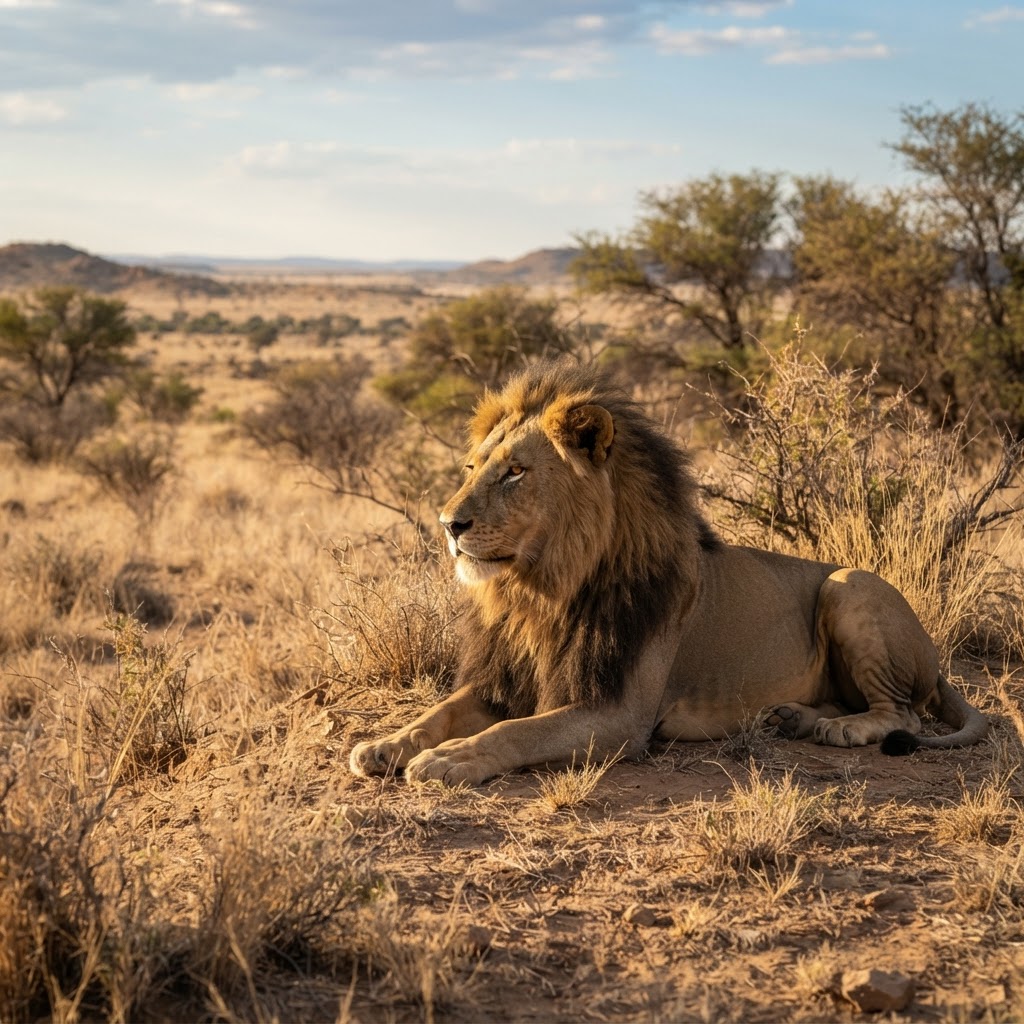
AI Generated
African Lion (South Africa & Namibia)
Panthera leo melanochaita
The African Lion in South Africa and Namibia is a powerful apex predator, known for its majestic presence and social behavior within prides.
The Southern Lion (Panthera leo melanochaita) is the lion subspecies found across much of eastern and southern Africa. It includes the lion populations of South Africa and Namibia and is characterized by the powerful build, broad head and prominent mane of mature males.
Adult males are considerably larger than females and may weigh well over 180 kg (400 lbs). Coat color ranges from pale tawny to darker brown, while mane development varies greatly between individuals and populations. Females lack a mane and are generally smaller and more lightly built.
Habitat & Range
The Southern Lion occurs across parts of eastern and southern Africa, including South Africa, Namibia, Botswana, Zimbabwe, Zambia, Mozambique, Tanzania and Kenya. Its current distribution is highly fragmented compared with its historical range. IUCN Red List
In South Africa and Namibia, lions inhabit savanna, semi-desert, open woodland, scrubland and dry bush country. Important populations survive in national parks, private reserves and community conservancies.
Behavior
Southern Lions are highly social and typically live in prides consisting of related females, their offspring and one or more adult males.
Males may also form coalitions, particularly before gaining control of a pride. Lions are most active during the cooler hours from late afternoon through the night and early morning, while much of the hottest part of the day is spent resting.
Territories are maintained through scent marking, roaring and direct defense against rival lions.
Diet
The Southern Lion is a powerful generalist predator feeding mainly on medium- and large-sized mammals.
Typical prey in southern Africa includes zebra, wildebeest, kudu, gemsbok, buffalo and warthog. Lions also scavenge opportunistically and may take smaller animals when available.
Females often hunt cooperatively, while large adult males are fully capable of bringing down substantial prey alone.
Hunting & Identification Notes
Mature males are identified by their large body size, broad head, heavy neck and developed mane. Signs of age and maturity, including facial scarring, worn teeth and overall body condition, can also be important when assessing an animal.
For trophy evaluation, skull size and overall maturity are important considerations. Mane size alone should not be used as an indication of age, as genetics, climate and habitat strongly influence mane development.
Lion hunting in South Africa and Namibia is strictly regulated, and requirements concerning age, permits, hunting areas and trophy export vary between countries and individual regions. Hunters should always rely on the professional hunter and current local regulations when determining whether a lion is legal and appropriate to hunt.
Conservation Status
The Southern Lion faces continuing pressure from habitat loss, fragmentation, declining prey populations and conflict with livestock owners.
Although some populations in southern Africa are stable or intensively managed, lions now occupy only part of their historical range. Conservation of large connected landscapes remains essential to the long-term survival of the subspecies. IUCN Red List
Sources
IUCN Red List — Southern Lion, Panthera leo melanochaita
IUCN Green Status — Southern Lion
ITIS — Panthera leo melanochaita
https://www.itis.gov/servlet/SingleRpt/SingleRpt?search_topic=TSN&search_value=726452
NCBI Taxonomy — Panthera leo melanochaita
https://www.ncbi.nlm.nih.gov/Taxonomy/Browser/wwwtax.cgi?id=3113013