
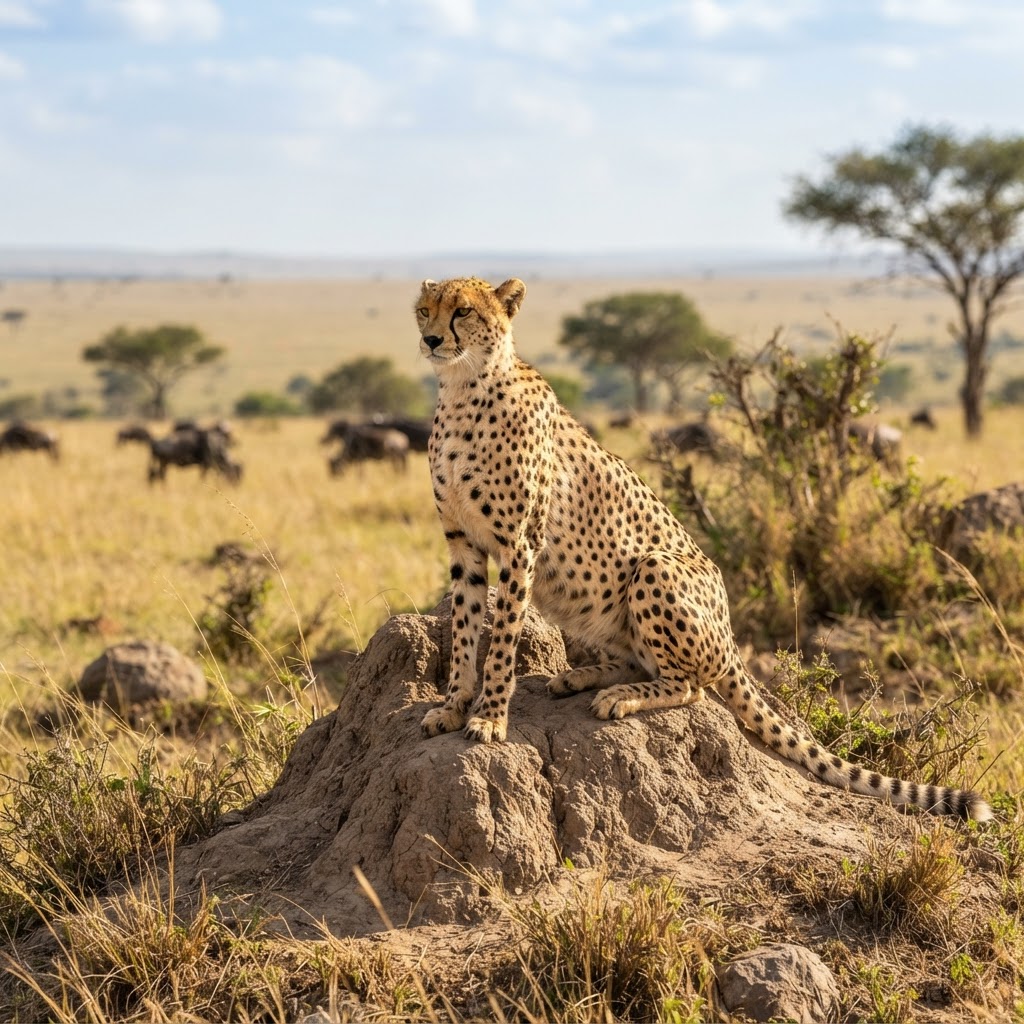
AI Generated
African Cheetah
Acinonyx jubatus
The African Cheetah is the fastest land animal, renowned for its incredible speed and distinctive spotted coat across African savannas.
The African Cheetah (Acinonyx jubatus) is a large, slender cat built for speed. It is easily recognized by its spotted coat, long legs, small rounded head and the distinctive black “tear marks” running from the inner corners of the eyes toward the mouth. It is the fastest land mammal, capable of reaching speeds above 100 km/h (62 mph) over short distances. cms.int
Adult males are generally larger than females, although both sexes share the same characteristic body shape. Unlike most other large cats, the cheetah has semi-retractable claws that provide additional grip during high-speed pursuit.
Habitat & Range
African Cheetahs occur in fragmented populations across eastern, southern and parts of northern and western Africa. Their strongest remaining populations are found in countries such as Namibia, Botswana, South Africa, Tanzania, Kenya, Zambia and Zimbabwe. mammaldiversity.org
They favor open habitats where their speed can be used effectively, including savannas, grasslands, semi-desert and open woodland. Cheetahs require large territories and may also occur extensively outside protected areas. IZW Cheetah Research Project
Behavior
Cheetahs are primarily active during daylight, particularly in the morning and late afternoon. This helps them avoid some competition with larger nocturnal predators such as lions and hyenas.
Females are usually solitary except when raising cubs, while males may live alone or form small coalitions, often consisting of brothers. Cheetahs rely heavily on eyesight when hunting and frequently use elevated positions such as termite mounds to scan for prey.
Diet
The African Cheetah is a specialized predator that primarily hunts small to medium-sized antelope. Typical prey includes gazelles, impala, springbok and young individuals of larger antelope species.
Rather than relying on ambush alone, the cheetah approaches as closely as possible before launching a short, extremely fast chase. Once prey is caught, it is usually killed by a bite to the throat.
Hunting & Identification Notes
The African Cheetah is unmistakable in the field. Its slim build, spotted coat, long tail and black facial tear marks distinguish it from the heavier-built leopard, which has rosette-shaped markings rather than solid spots.
Where legal hunting occurs, cheetahs are subject to strict national and international regulation. CITES lists the species in Appendix I, although specific trophy export quotas exist for certain southern African populations. CITES
Because males and females can appear similar at distance, positive sex identification is essential wherever hunting regulations distinguish between them.
Conservation Status
The African Cheetah is classified as Vulnerable on the IUCN Red List. Its remaining range represents only a small fraction of its historical distribution, with populations increasingly fragmented across the continent. CITES
Major threats include habitat loss and fragmentation, declining prey populations, conflict with livestock owners and illegal wildlife trade. Cheetahs naturally occur at low population densities and require very large home ranges, making them particularly vulnerable to landscape fragmentation. CITES
Sources
Mammal Diversity Database — Acinonyx jubatus
https://www.mammaldiversity.org/taxon/1005979/
Convention on Migratory Species — Acinonyx jubatus
https://www.cms.int/species/acinonyx-jubatus
CITES — Cheetah
https://cites.org/eng/gallery/species/mammal/cheetah.html
Animal Diversity Web — Acinonyx jubatus