
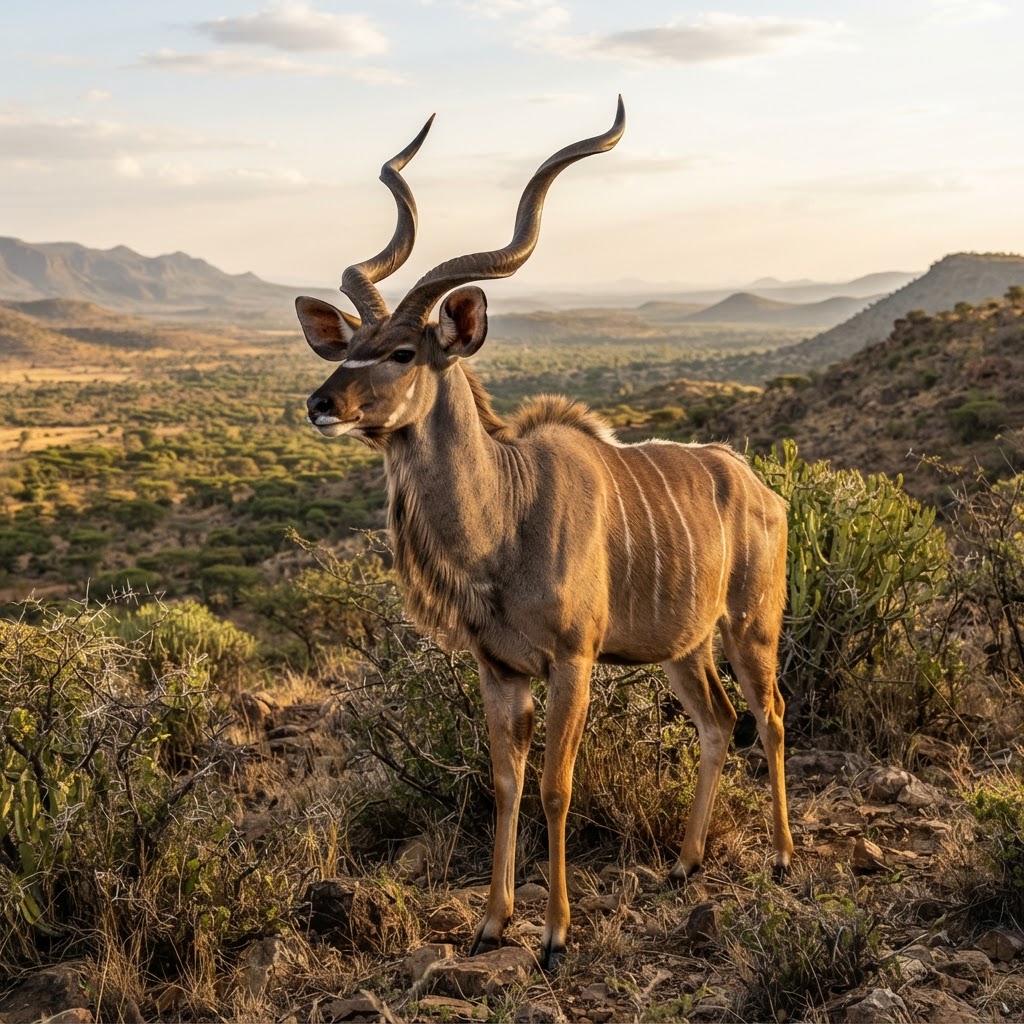
AI Generated
Abyssinian Greater Kudu
Tragelaphus strepsiceros chora
The Abyssinian Greater Kudu is a majestic antelope subspecies known for its impressive spiraled horns and striped coat.
The Abyssinian Greater Kudu (Tragelaphus strepsiceros chora) is a large spiral-horned antelope found in northeastern Africa. Mature bulls are imposing animals, with long corkscrew horns, a grey-brown coat and a series of pale vertical stripes along the body.
Adult males are considerably larger and heavier than females and develop the species’ characteristic spiralling horns. Females are hornless and generally lighter in build. Bulls also tend to become darker with age and often develop a pronounced mane along the neck and back.
Habitat & Range
The Abyssinian Greater Kudu occurs mainly in Ethiopia and neighboring parts of northeastern Africa, including Eritrea, Sudan and northern Kenya. It inhabits dry woodland, broken bush country, wooded hills and areas with a mixture of cover and open feeding ground. NCBI
Its preference for rugged, brush-covered terrain gives it both shelter and access to a wide range of browse.
Behavior
Abyssinian Greater Kudu are generally shy and cautious. Females are often found in small groups, while mature bulls may be solitary or associate with other males outside the breeding season.
They are most active during the cooler parts of the day and rely heavily on cover when disturbed. Despite their size, kudu can move remarkably quietly through dense vegetation.
Diet
The Abyssinian Greater Kudu is primarily a browser, feeding on leaves, shoots, shrubs, herbs and other woody vegetation.
Its varied diet allows it to survive in relatively dry environments, especially where sufficient browse and seasonal water are available.
Hunting & Identification Notes
Mature bulls are identified by body size, darker coloration and the development of long, deeply spiralled horns. Trophy assessment focuses primarily on horn length, spread, mass and the depth and symmetry of the spiral.
Hunting usually involves glassing wooded slopes, valleys and bush-covered hills during early morning and late afternoon. Mature bulls can be difficult to spot because their striped coat blends exceptionally well with broken light and vegetation.
The Abyssinian form is traditionally distinguished from southern Greater Kudu populations by geography and classification as T. s. chora, although modern taxonomic treatments differ on whether it should be recognized as a separate subspecies or included within Greater Kudu more broadly. NCBI
Conservation Status
Greater Kudu are currently considered widespread and are generally assessed as Least Concern at species level. Local populations may nevertheless be affected by habitat loss, agricultural expansion and hunting pressure. ebi.gov.et
Sources
Mammal Diversity Database — Greater Kudu
https://www.mammaldiversity.org/taxon/1006283/
NCBI Taxonomy — Tragelaphus strepsiceros chora
https://www.ncbi.nlm.nih.gov/Taxonomy/Browser/wwwtax.cgi?id=141460
ITIS — Northern Kudu / Strepsiceros chora
https://www.itis.gov/servlet/SingleRpt/SingleRpt?search_topic=TSN&search_value=1277537