
AI Generated
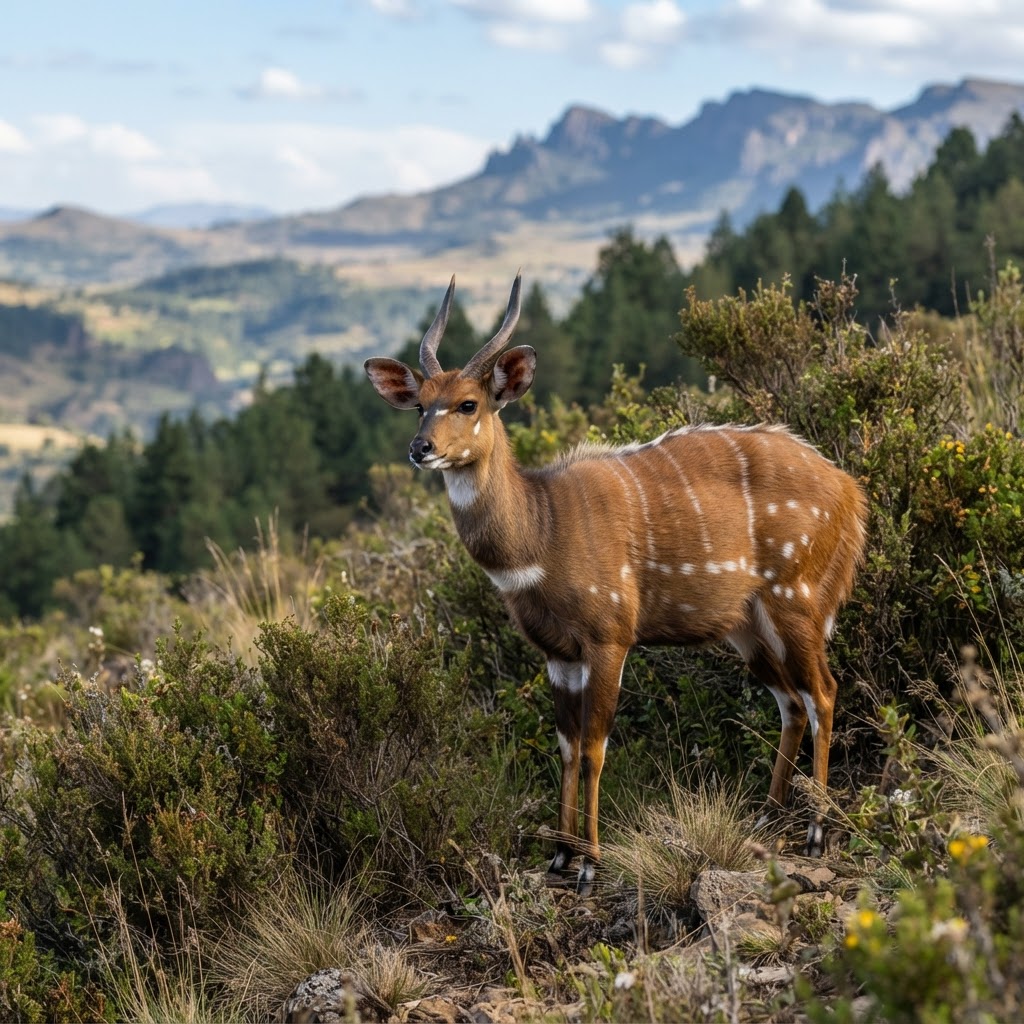
Abyssinian Bushbuck
Tragelaphus scriptus meneliki
The Abyssinian Bushbuck is a secretive antelope subspecies inhabiting dense thickets and forests of East Africa, known for its striking coat.
The Abyssinian Bushbuck (Tragelaphus scriptus meneliki) is a medium-sized antelope with a compact body, large ears and the characteristic spiral horns of the bushbuck group. Adult males generally become darker with age, while females are lighter and more reddish-brown.
Only males carry horns. These rise from the skull and form a distinctive spiral, becoming heavier and more impressive with maturity. Coat pattern and coloration can vary considerably between individuals and populations.
Habitat & Range
The Abyssinian Bushbuck is associated primarily with the Ethiopian highlands, where it inhabits montane forests, wooded valleys, forest edges and areas of dense bush.
It depends heavily on thick vegetation for shelter and is rarely found far from cover. Its ability to live at relatively high elevations distinguishes it from many lower-altitude bushbuck populations.
Behavior
Abyssinian Bushbuck are generally solitary and secretive. They spend much of the day concealed in dense vegetation and are most active during the early morning and late afternoon.
When disturbed, they may remain motionless in cover before suddenly breaking away. Their preference for thick vegetation can make them difficult to observe even in areas where they are relatively common.
Diet
The Abyssinian Bushbuck is primarily a browser, feeding on leaves, shoots, herbs, shrubs and other soft vegetation.
Its flexible diet allows it to exploit a wide variety of forest and woodland habitats throughout the year.
Hunting & Identification Notes
Mature males are identified by their heavier build, darker coloration and well-developed spiral horns. Horn length, mass, shape and symmetry are important characteristics when assessing a mature trophy.
Because bushbuck spend much of their time inside dense vegetation, hunting typically involves careful glassing of forest edges, valleys, clearings and other openings during the first and last hours of daylight.
Positive identification is particularly important in Ethiopia, where more than one geographically distinct bushbuck form has historically been recognized in hunting and zoological classifications.
Conservation Status
Bushbuck remain widespread across much of sub-Saharan Africa, although individual populations may face pressure from habitat loss, agricultural expansion and hunting.
The complex taxonomy of African bushbuck means that conservation assessments are generally made at the broader species or population level rather than specifically for the Abyssinian form.
Sources
Mammal Diversity Database — Tragelaphus scriptus
https://www.mammaldiversity.org/taxon/1006281/
Zoological Journal of the Linnean Society — Bushbuck taxonomy
https://academic.oup.com/zoolinnean/article/200/2/532/7281963
ITIS — Tragelaphus scriptus meneliki
https://www.itis.gov/servlet/SingleRpt/SingleRpt?search_topic=TSN&search_value=898744