
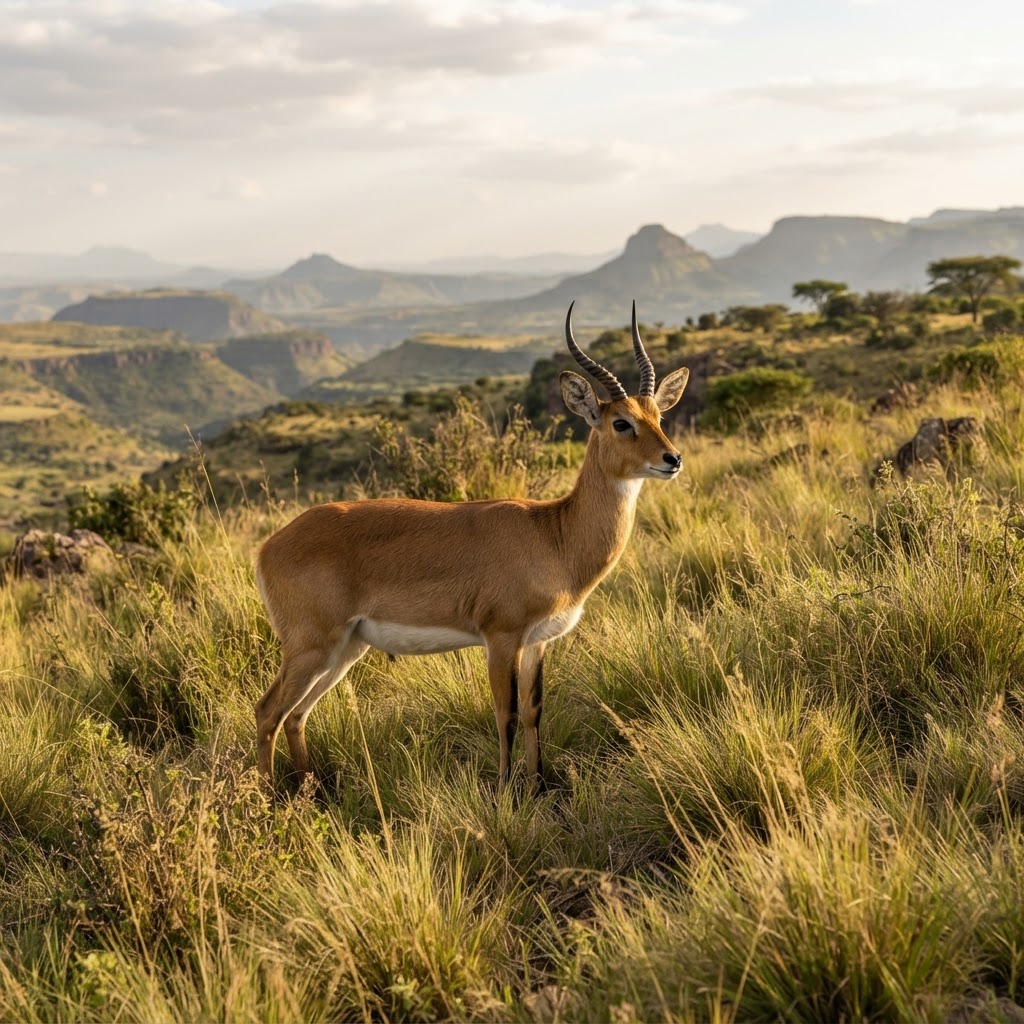
AI Generated
Abyssinian Bohor Reedbuck
Redunca redunca bohor
Discover the Abyssinian Bohor Reedbuck, a compact antelope native to Ethiopia. Learn about the physical traits, distinct forward-curving horns of the males, and the diverse habitats they occupy, from lowland grasslands to high-altitude Ethiopian mountain ranges.
The Abyssinian Bohor Reedbuck (Redunca redunca bohor) is one of the recognized subspecies of Bohor Reedbuck. It has a compact build, relatively short legs and a yellowish to golden-brown coat, with lighter coloration on the underparts.
Adult males are larger and heavier than females and are the only sex to carry horns. The horns rise from the top of the head before curving distinctly forward, with pronounced ridges along much of their length. Females are hornless and generally more lightly built.
Bohor Reedbuck are medium-sized antelope, with adult males typically standing around 75–90 cm at the shoulder. Animal Diversity Web
Habitat & Range
The Abyssinian Bohor Reedbuck is primarily associated with Ethiopia, where it occurs from lowland grasslands to high-altitude areas above 3,000 metres. It has also historically been recorded around the Blue Nile region of Sudan. PubMed Central (PMC)
It favors open grasslands, floodplains, marshes and areas close to permanent water. Tall grass and nearby cover are particularly important, providing both feeding opportunities and protection.
Behavior
Abyssinian Bohor Reedbuck are usually seen alone, in pairs or in small groups rather than large herds. They are most active during the cooler parts of the day, particularly early morning and late afternoon.
When disturbed, they typically remain concealed until danger comes relatively close before breaking cover at speed. Their tendency to disappear into tall grass can make them surprisingly difficult to relocate once alerted.
Diet
The Abyssinian Bohor Reedbuck is primarily a grazer, feeding on grasses and tender shoots. Studies in Ethiopia show a preference for nutritious vegetation with relatively high protein and lower fibre content. PubMed Central (PMC)
Its distribution is strongly linked to water and productive grasslands, although its exact diet varies with season and habitat.
Hunting & Identification Notes
For hunters, the characteristic forward-curving horns of mature males are the most important identification feature. Trophy evaluation is primarily focused on horn length, mass and overall symmetry.
The Abyssinian Bohor Reedbuck is smaller-horned than several other Bohor Reedbuck forms. Rowland Ward currently lists a minimum of 8 inches (20.5 cm) for the Abyssinian Bohor Reedbuck, with the listed record measuring 12 6/8 inches (32.4 cm). Rowland Ward
Because reedbuck often remain hidden in grass before suddenly breaking cover, careful identification of sex and trophy quality before shooting is important.
Conservation Status
The Bohor Reedbuck (Redunca redunca) is currently assessed as Least Concern, although populations are considered to be declining overall. Habitat conversion, agricultural expansion and hunting pressure remain important local threats.